Reinvest the 1% Meals Tax on Main Street Connecticut
Written for Beverage Journal
Every restaurant owner and hotelier in Connecticut knows the Main Street story. It’s the story of the corner bistro that anchors a downtown, the historic inn that turns a town into a weekend destination, and the local taproom that breathes life into a repurposed mill. These businesses are more than just employers; they bring character and charm to our 169 cities and towns.
They are also an incredible economic engine. Our industry generates more than $1.1 billion in annual state sales tax revenue. However, for years, a specific piece of that engine has been running on a one-way street.
In 2019, Connecticut’s meals and beverage tax was increased from 6.35% to 7.35%. At the time, that 1% surcharge was a necessary move to help stabilize the state’s General Fund. Today, the state is on much more stable financial footing, yet that 1% surcharge, which generates more than $100 million annually, funnels directly into the General Fund. Not a single dollar of it returns to the municipalities that generated it, and not a single dollar is reinvested into the tourism marketing that brings guests through our doors.
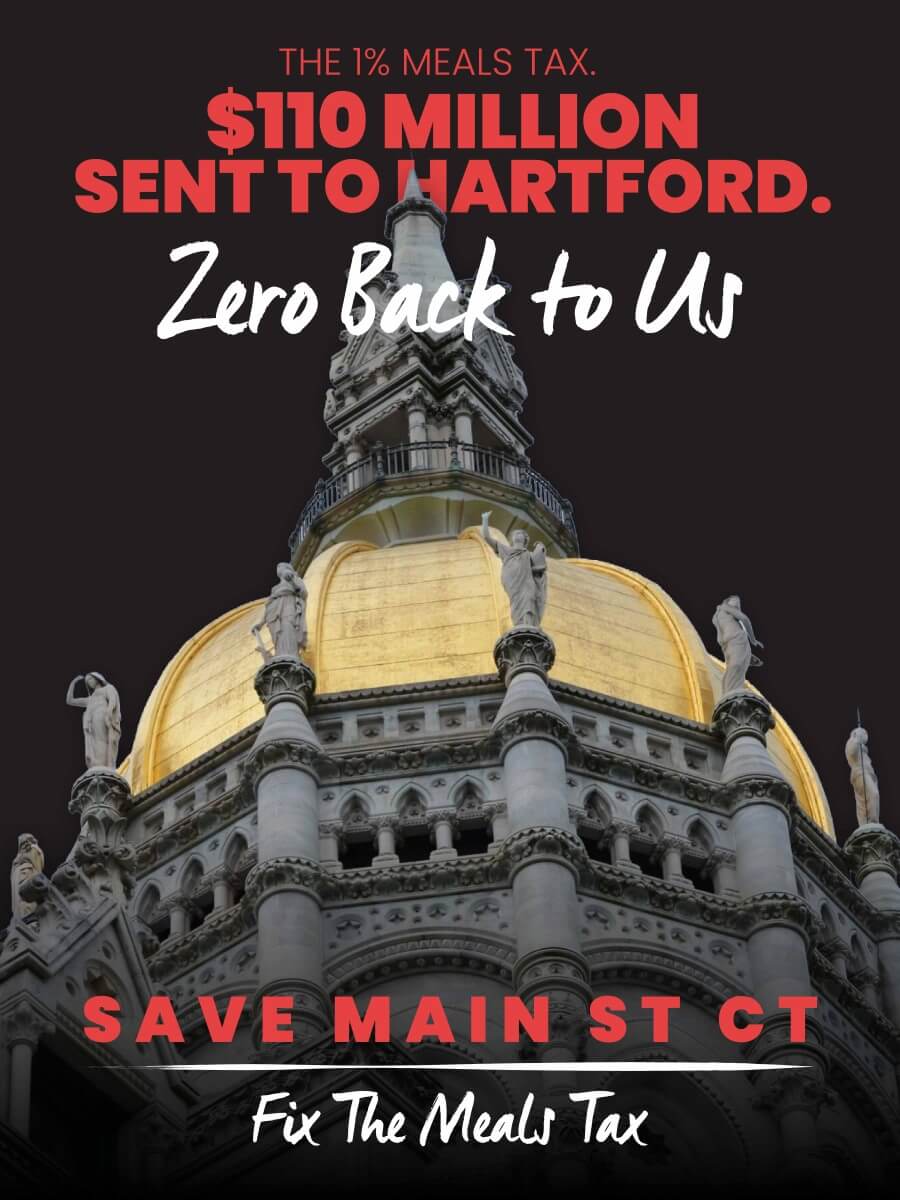
That is why the newly evolved Connecticut Restaurant & Hospitality Association (CRHA) has made Senate Bill 2 our primary focus this legislative session.
As you may know, we recently transitioned from the CRA to the CRHA. We did this because restaurants and hotels are inseparable parts of the same ecosystem. A guest at a hotel in Mystic or Stamford isn’t just looking for a bed; they are looking for a great meal and a local experience. By unifying our voice, we have created a more powerful coalition to fight for a simple, common-sense fix: Fix the Meals Tax.
Fixing SB-2 won’t increase taxes – it will simply reallocate the revenue already being collected at our tables and front desks. We are proposing a 50/50 split: 50% of that 1% surcharge should return directly to the town where it was earned, and 50% should be dedicated to a statewide tourism fund.
For our local mayors and town managers, this represents a transformative reinvestment. Right now, municipalities are suffocating under fixed costs, including but not limited to rising health insurance premiums, energy spikes, and inflation. By returning a portion of the meals tax, we give towns the resources to invest in their own hospitality districts, whether through local marketing, infrastructure improvements, or small business grants.
There is also a very real crisis in our industry which runs deep here in Connecticut: the lack of tourism funding. Connecticut’s marketing budget has been slashed by 60% in recent years, leaving us with little support to compete with our neighbors in New York, Massachusetts, and Rhode Island. We know that for every $1 invested in tourism marketing, the state sees a return of at least $3.50 in tax revenue. By dedicating half of the meals tax to this effort, we stop playing defense and start telling Connecticut’s story to a national audience.
Right now, the legislative session is in full swing. Regardless of where the bill sits on the legislative calendar, the reality remains the same: the hospitality industry is one of the most prominent employers in the state, and we can no longer be treated as a rounding error in the state budget.
We have spent years navigating the headwinds of labor shortages, supply chain spikes, and rising costs. We have stood by our communities through the most difficult era in hospitality history. Now, it is time for the state to stand by us.